



Longevity is not just about living longer — it is about living better for longer. Longevity is sometimes viewed as something only rich people or a small group of lucky people can access. But a longer and healthier life is not only about money or special treatments — it is about prevention, healthy habits, and taking care of your body early. It is about changing the way we think about health. Instead of waiting until we become seriously ill, we can focus on finding problems early and taking action before they grow. For example, a person does not need to wait for chest pain or serious symptoms before seeing a doctor. Regular health checks, better food choices, exercise, and good daily habits can help find risks early and support a longer, healthier life.
What is healthspan and lifespan?
For a long time, medicine focused mainly on lifespan — the number of years a person lives. A longer life was seen as the biggest success. But living longer does not always mean living better. Many people spend their later years dealing with long-term illnesses, pain, or a loss of independence. This is where healthspan becomes important. Healthspan means the number of years a person lives in good health, with energy, strength, and freedom from serious disease.
The goal of longevity medicine is not just to help people live longer. It is to help people stay healthy, active, and independent for as many years as possible. The real goal is simple: not only more years of life, but more healthy years of life.
What is Longevity Medicine?
Longevity medicine is a field of healthcare focused on helping people age in a healthier way. It combines different approaches, such as:
- Healthy lifestyle changes — improving diet, exercise, sleep, and daily habits.
- Preventive healthcare — finding health risks early and taking action before problems become serious.
- Medical treatments — using medicines and therapies that may help slow age-related changes.
- Advanced technologies — using new tools and innovations to better understand and support human health.
The main goal of longevity medicine is not only to help people live longer, but to help them stay healthier, more active, and independent as they age.
For Example, instead of waiting until a person develops heart disease or diabetes, longevity medicine focuses on early checks, healthy habits, and personalized care to reduce risks and support a better quality of life.
The Longevity Pyramid: A Framework for Healthy Aging
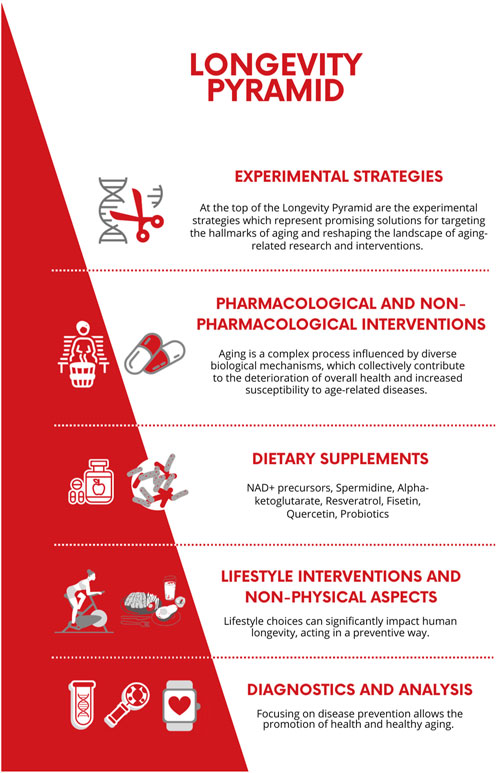
Andela Martinović and colleagues introduced the “Longevity Pyramid” as a way to organize the different approaches used in longevity medicine. It shows that healthy aging is built step by step, starting with basic health foundations and moving toward more advanced technologies.
- Foundational diagnostics & early detection
The first step is understanding your current health and finding risks early. This includes tools such as biomarker testing, genetic and epigenetic tests, wearable devices, and advanced health screenings. - Lifestyle interventions
Healthy daily habits are the foundation of longevity. This includes regular exercise, balanced nutrition, quality sleep, good oral health, and other positive behaviors. - Targeted supplements
Some supplements are designed to support specific processes in the body that are connected to aging. They aim to help maintain healthy cellular function. - Pharmacological and non-pharmacological tools
This level includes medications and other medical treatments that may help reduce the risk of age-related diseases or improve health. - Experimental strategies
At the top of the pyramid are the newest and most advanced areas of research, including gene editing, stem cell therapies, and tissue engineering. [1]
Arteriograph: Advanced Longevity Measurement Device
The principles of longevity medicine represent a major shift: moving away from treating disease only after it appears and toward early detection, prevention, and personalized health management.
The Arteriograph fits naturally into this approach because it focuses on one of the most important systems in aging: the cardiovascular system.
- Measuring Biological Age — Starting With the Arteries
Long before biological age became a popular concept in longevity medicine, the Arteriograph was already built around this idea.
While chronological age tells us how many years a person has lived, arterial age shows how old the vascular system actually is.
The condition of the arteries is influenced by:
- lifestyle,
- genetics,
- blood pressure,
- physical activity,
- metabolic health.
Example:
Two people who are both 55 years old may have different arterial ages. One may have healthy, flexible arteries similar to a younger person, while another may show signs of faster vascular aging.
By measuring arterial health, the Arteriograph provides an important insight into biological aging.
- One Tool Among Many — Completing the Diagnostic Picture
Longevity medicine does not rely on one measurement alone.
Just as biological age requires multiple biomarkers and tests, cardiovascular aging requires a combination of information.
The Arteriograph contributes an important part of this picture by providing a detailed cardiovascular assessment with 15 different parameters.
These measurements offer insight into:
- arterial stiffness parameteres such as Pulse Wave Velocity,
- vascular function,
- cardiovascular risk,
- overall vascular biological age.
Basically, Arteriograph helps create a more complete understanding of a person’s health.
- A Medical Measurement, Not Just a Consumer Device
Within the Longevity Pyramid, physiological measurements have a central role because they provide objective information about how the body functions.
The Arteriograph belongs to this category.
Unlike consumer wellness gadgets, Arteriograph is a medical device designed to provide a detailed cardiovascular profile within a minute.
This makes it suitable for longevity centers because it offers:
- clinical-grade measurement,
- repeatable testing,
- easy integration into preventive health programs.
- Measuring the Impact of Lifestyle: The Connection Between Exercise and Vascular Health
Lifestyle interventions are one of the most important parts of longevity medicine.
Exercise, for example, can:
- reduce oxidative stress,
- improve blood vessel function,
- support vascular repair,
- promote healthier aging.
However, lifestyle improvements are most valuable when their effects can be measured.
This is where the Arteriograph adds additional value.
Through parameters such as the Augmentation Index (AIx), the device can assess endothelial function — an important marker of vascular health.
Example:
A person who begins a regular exercise program may use Arteriograph measurements over time to see whether their vascular function improves.
This creates a measurable connection between lifestyle choices and biological changes.
Why Diagnostics Matter in Longevity
Diagnostics are the starting point of personalized longevity because:
“You cannot improve what you do not measure.”
By combining blood biomarkers, genetic information, wearable technology, physiological testing, and tools such as the Arteriograph, longevity medicine can move from reactive treatment toward proactive health optimization.
The goal is not only to detect disease earlier.
The goal is to understand aging, prevent decline, and help people maintain health, vitality, and independence for as long as possible.